
Uncategorized
Like a scene from an Outlander episode.
Aug
Sometimes it feels like I have been living an outlander story in my head my whole life. Ever since my youth I have always dreamed of meeting historical figures I admire, so the wonderful series by Diana Gabaldon really hits home with me. In many ways this childhood desire is the driving force behind most of my art.
Very high on my list of people to meet is Leonardo da Vinci. In fact I would live to spend time with the three titans of the renaissance rounded out by Michelangelo Buonarroti and Raffaello Sanzio. As I started to visualize how I could get time with da Vinci, I find myself standing in an unfamiliar place, not quite sure where exactly or when for that matter. Trying to remain inconspicuous, I carefully try to orient myself. I was hearing what sounded like some Italian dialect, which is a good sign, though of limited value since my (modern) Italian is very minimal.
I make my way out of an alley and hope to blend in as best I can. “Interesting” smells everywhere. It’s pretty early as dawn is beginning to break. Where am I and how do I find da Vinci ? I take steps carefully, everything is still foggy to me as I turn a corner into the open. I am hit by a tremendous force and fall to the floor. Now I am wet all over, and the smell is pretty awful. Another man is also trying to stand up and I realize that in his haste we smashed into one another. Now he is screaming at me (I don’t understand most of it but it’s not good). Still I am trying to help him up and show expressively that I am sorry. As I see his face I realize he is bleeding from his nose. Did I break his nose ? I hand him some tissues and notice that my clothes are also slightly torn and I am a bit bruised on one elbow. Nice start.
The man is less than thrilled realizing he is bleeding, but he seems to get it was an accident and as much his fault as mine. He is bearded and perhaps mid40s or 50s. Hard to say exactly as people back then looked much older than their years. He looked like he had decent clothes but very worn, so he was not a street beggar though he certainly looked like he could use a bath (I should talk after what I fell into). The light was still dim and as he continued to tend to his wound, I was beginning to make out his face, and it seemed familiar.
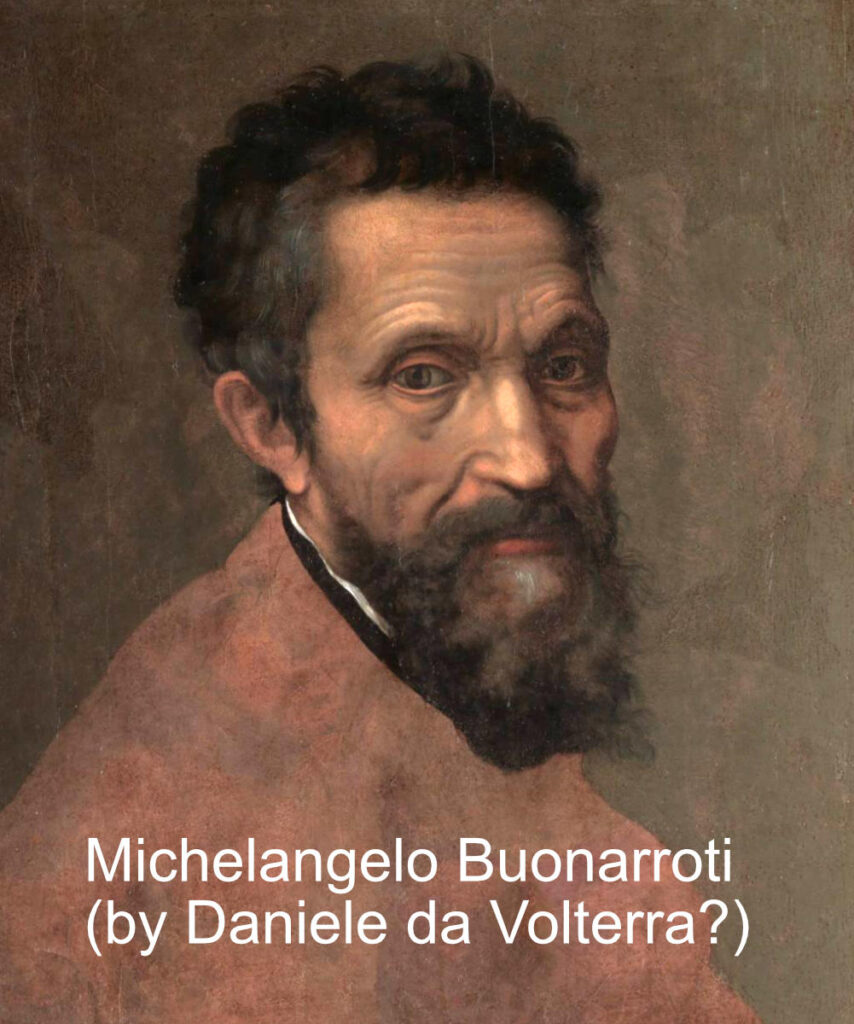
I don’t think he cared for my stare, but I could not help it as I had suddenly realized who I was face to face with. Mr. Buonarroti himself. Michelangelo. What have I done ? I had just struck Michelangelo. As I tried to gather my wits, pick up my little bag with my phone and other useless things, a million thoughts went through my head. How do I converse with him and watch him work, dare I hope. What is he working on now. How do I not lose him. I had already forgotten that I was trying to find da Vinci.
It was only a moment that I was distracted, in shock, and then the worst thing that could happen. He’s gone. Just like that. Did I imagine it. No. my head still hurts. Now what… How do I find him ?
Just then I am approached by a man who I am guessing saw the whole incident. Realizing I was not a native he started speaking to me in broken French, and of course I answered gladly. He said I was lucky to have survived that ordeal with il Divino Michelangelo. I asked if he knew him, as I had traveled very long and far to meet Michelangelo. He said no he did not know him personally but he said he had a friend, a secretary in the papal household who may be able to help. He was meeting him at noon and for the right gift he would be willing to introduce me. Whether I trusted this or not is irrelevant as he was my only hope. I came prepared expecting such situations so I offered the man a silk scarf, but he was not interested so I tried a piece of silverware and that was acceptable. We agreed on the meeting place and now it was just a matter of waiting. From speaking to him I gathered that I am in Rome which seemed to match what I was seeing, but when ?
As I sat trying to stay mostly out of sight, I could see the streets of Rome stirring to life with the muffled clatter of wagon wheels on cobblestones and the faint smell of baking bread drifting from numerous ovens. The air was cool, still holding the dampness of dawn, but already the sun was rising over the terracotta rooftops, catching in little bursts on gilded crosses and marble cornices. Merchants were setting out bolts of cloth, and apprentices hurried with baskets of pigments and brushes for their masters.
After another bribe we were on our way, the three of us as I still needed my translator. As we headed towards the Sistine Chapel I presumed it had to be mid 1530s or perhaps later just based on Michelangelo’s look. At this point it became clear to me that I would not have found da Vinci anyhow as he would have passed away some 15 years earlier. My thoughts and excitement are interrupted by my guide’s warnings as they prepared me for what’s to come. “il Divino is a storm. Do not try to charm him. Speak only if spoken to. Do not startle him. And speak honestly and not with false praise.” (How does one give false praise to MICHELANGELO I wondered ???)
The guard at the bronze doors recognized the secretary’s signet and waved us through into the Apostolic Palace. Incredible. The hush was immediate. The city’s noise, the teaming life had disappeared — here, every step seemed to echo in vast, stone corridors hung with tapestries of deep crimson and gold. The scent shifted too: beeswax polish, incense lingering from morning Mass, and the faint mineral tang of wet plaster from somewhere above. (It was hard to contain my excitement and a little trepidation I have to say, as it suddenly hit me that I was responsible for Michelangelo‘s injury so what would he do if he saw me again ?)
As we climbed a narrow staircase, they whispered, “He works high on the scaffold. Stay quiet.”
At the top of the scaffold, the space opened up into an expanse of pale, wet plaster that curved over your head and down the altar wall like a white cliff face. Figures — dozens, no, hundreds — seemed to writhe and surge from it: muscular bodies twisting in panic or straining upward in hope, angels blowing their trumpets, Christ at the center like a sun about to explode.
And there, balanced on the narrow plank, stood Michelangelo.
He was shorter than you expected — solid, compact — with powerful forearms dusted in blue pigment, hair graying at the temples and tied back carelessly. His brow was furrowed, lips pressed tight as he guided a fine brush across the thigh of a soul being dragged toward Hell. Every so often, he would step back, squint, mutter under his breath, and mix a touch of darker ultramarine into the wet paint.
The secretary cleared his throat gently.
“Maestro, there are two visitors come to see your work.”
Michelangelo didn’t even turn around (fortunately for me).
After some moments which seemed like an eternity he spoke “They call this The Last Judgment,” he continued, jerking his head toward the wall. “But I do not paint judgment for the sake of the popes. I paint it because it is what I see when I close my eyes.” (Brutal honesty I thought)
His brush traced another shadow into the folds of a shroud. I was far enough away that I thought perhaps he may not recognize me, but was still careful to hide my face a bit. Still I could see the unfinished masterpiece looming with unsettling life. The blues were deep and cold, drawn from lapis lazuli worth more than gold. The flesh tones shifted from luminous ivory to a sickly green-gray where the damned were dragged downward. I could still see some faint underdrawings in places — restless lines in charcoal — where the maestro had altered a figure’s arm or twisted a torso to make the struggle more violent.
Below, a few assistants moved like ants, grinding pigments, heating glue, hauling buckets of lime plaster up the ladders. Yet Michelangelo never lost focus as he continued to work almost unaware of them.
“Do you believe,” he asked suddenly, “that beauty can save a soul?” The question caught you off guard.
But I knew enough Italian to say yes, carefully.
He gave a short laugh — not mocking, but almost weary. “Then you have the right answer. Beauty does not save. It condemns as often as it redeems. It makes you see, and once you have seen, you cannot look away.” (Again he seems to be self-reflecting)
He gestured toward the damned — their faces contorted in despair, bodies tangled with demons. “Do you see the boat there?” Pointing to Charon from the underworld — lashing at the souls with his oar. “That is from the old poets, not the church. I put him here because Hell is not only theirs. It is ours.”
Practically speaking I did not exactly expect to get pointers, and it’s such an intimidating situation, which had already started on the wrong foot that I suppose I should be happy with what I got. Just then The secretary nudged me — time’s up. Michelangelo was already bent over his work again, the rest of the world forgotten.
As we descended the scaffolding, the massive wall filled our view from below: Christ’s hand raised in terrible finality, angels swirling in a vortex of light and shadow, humanity naked and exposed before the last moment of all things.
As we head into the light, the city outside seemed smaller, almost fragile, after the vision we had just witnessed inside. And I am not just referring to the artwork. The impact of the frescoes stayed with me as did Michelangelo’s words — that beauty could not save us, but it could leave us forever unable to look away. I had never felt such inspiration before and understood just how fortunate I was to have had those brief moments to be in the presence of il Divino. Maybe I’ll be lucky, and something rubs off.